
 EN
 Romana
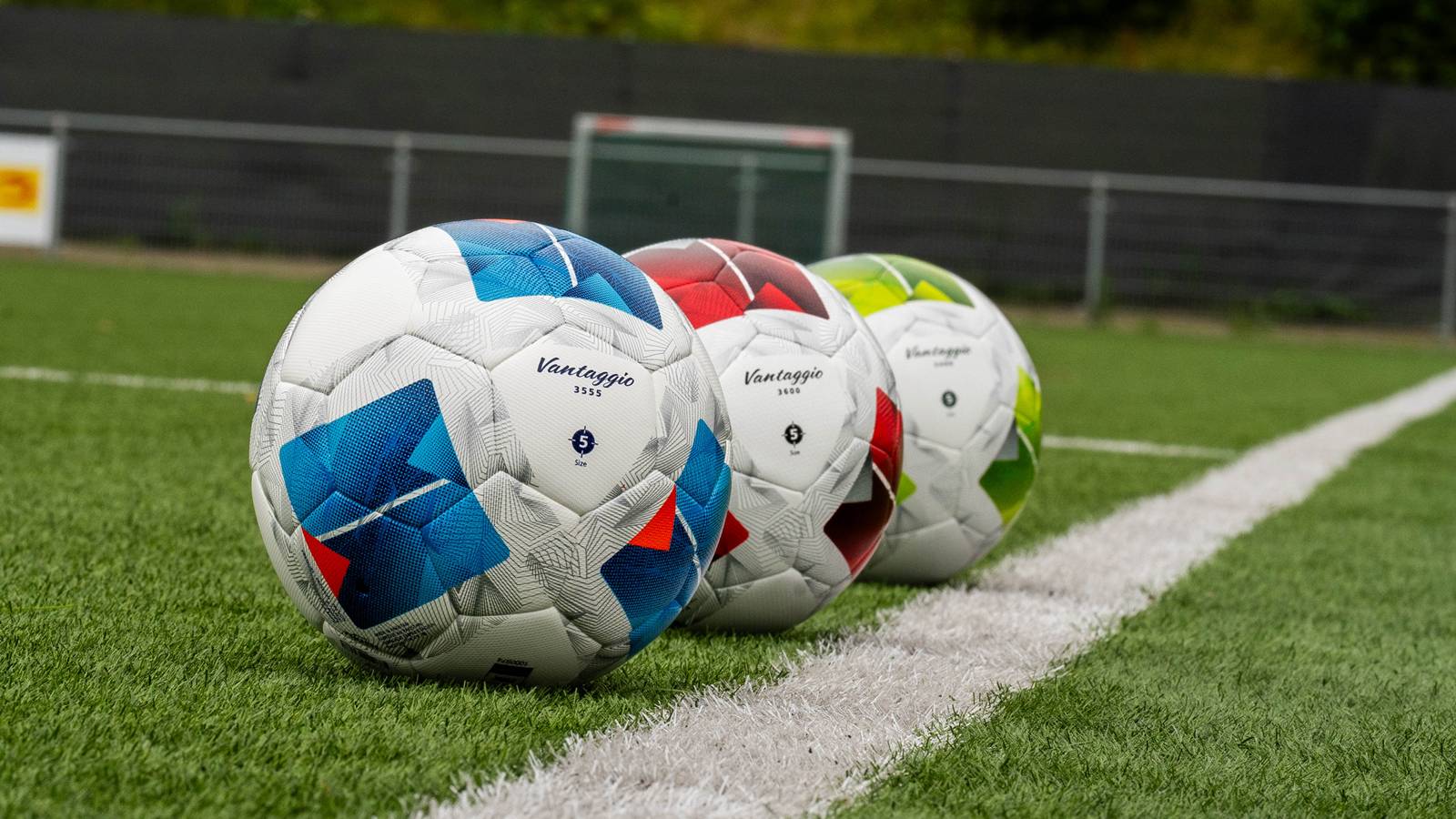
Choosing a football starts with a few simple questions: who will use it, what surface will it be used on, and whether it is needed for training or matches.
For children, both size and weight matter. For clubs and schools, the number of balls, durability and playing surface are important. For competitions, you should also check the certification required by the competition rules.
The Molten Vantaggio range includes models for each of these situations: hand-stitched balls, hybrid balls, lightweight versions and match balls made with ACENTEC technology.
In this guide, we explain the differences between the models and help you choose the right football.
How to choose a football
- For children and beginners: choose a size and weight suitable for their age and the coach's recommendations.
- For schools and recreational play: choose a training ball suitable for the playing surface and budget.
- For club training: check the construction, recommended surface and number of balls required.
- For matches and competitions: check the size, weight and certification required by the rules.
- For artificial turf: check whether the manufacturer recommends the model for this surface.
- For futsal: choose a ball specifically designed for indoor play.
- For beach soccer: use a ball designed for playing on sand.
Molten Vantaggio: a short history
Molten is a Japanese company founded in 1958, known for its balls and equipment used in football, basketball, volleyball, handball and other sports.
The Vantaggio football range was introduced in 2004. In the same year, Molten launched a football featuring its proprietary ACENTEC technology, based on thermally bonded panels. Since then, the range has undergone several design and construction updates.
In European football, Molten supplied the official match balls for the UEFA Europa League from the 2018/2019 season and later for the UEFA Europa Conference League. Molten's role as official ball supplier for these competitions continued until 2024.
Molten Vantaggio generations
Over the years, Molten has updated the design and improved certain features of the Vantaggio range. The generation refers to the evolution of the range, but each model should be checked separately: balls within the same series may have different materials and constructions.
First generation
The Vantaggio range was introduced in 2004. Its launch was associated with Molten ACENTEC technology, developed to thermally bond the ball's panels.
Fourth and fifth generations
Molten states that the fourth and fifth generation designs used geometric motifs inspired by the shape of the football pitch.
A representative model from the fifth generation is the Molten F5N5000, a size 5 match ball made with ACENTEC technology and certified FIFA Quality Pro.
According to Molten, starting with the fifth generation, the top model uses an adhesive with improved resistance to high temperatures. It is designed to reduce the risk of panels coming loose in demanding conditions, including on hot artificial turf.
These features do not automatically apply to every model with the letter N. For example, the F5N1710 is hand-stitched, while the F5N3400-G has a hybrid construction.
Sixth generation
In October 2026, Molten announced the sixth generation Vantaggio, presenting the F5T5000 as its top model.
The new model is size 5, with a PU cover and ACENTEC construction. Its design retains elements from previous generations and adds graphics intended to suggest movement.
Molten announced the range update for 2027. Availability in Romania is yet to be confirmed. The announcement mentions FIFA approval, without specifying the exact certification level in its product table.
What do Molten football codes mean?
The code helps identify the ball, its size and model. Let's use F5N3400-G as an example:
- F: a ball from the football range;
- 5: size 5;
- N: the series used in the product code;
- 3400: the model in the range;
- -G: a model variant that should be checked in the product description.
Other examples:
- F4N1710: football model, size 4;
- F5N3555: football model, size 5;
- F5N5000: Vantaggio 5000, size 5;
- F5T5000: the 5000 model presented for the sixth generation.
The code alone does not establish the cover material, bladder, recommended surface or certification. These details should be checked for the exact model and version.
What football size should you choose?
Footballs are available in several sizes. For children, the choice depends on age, playing level and competition rules.
- Size 1: mini ball for skill exercises, collecting or promotional use.
- Size 3: introduction and training for younger children.
- Size 4: children and junior players, depending on the age category.
- Size 5: older juniors and adults; the standard size for senior football.
The age recommendations for each size may vary between competitions and federations. For training, ask the coach for a recommendation; for matches, check the organiser's rules.
What are the dimensions of a standard size 5 football?
According to the Laws of the Game, a standard match ball must have:
- Circumference: 68–70 cm;
- Weight at the start of the match: 410–450 g;
- Pressure: within the range specified by the rules.
These values apply to a standard match ball. Light and Super Light models can have the same size but a lower weight.
Light and Super Light footballs for children
A lightweight football can have the dimensions of a size 4 or size 5 ball while weighing less than a standard ball. It can be used for introductory exercises and training adapted to children.
Size and weight should be checked separately.
- F4A3129-O: size 4, approximately 290 g, Super Light;
- F5A3129-O: size 5, approximately 290 g, Super Light;
- F5N3135-Y: size 5, approximately 350 g, Light;
- F3A3400-G: size 3, approximately 290 g, Light;
- F4N3400-G: size 4, approximately 350 g, Light.
Other series may also be available, such as F4A3129-O or F5A3129-O. Always check the complete product code and weight on the product page.
For matches, choose a ball that meets the rules for the relevant age category.
Training ball or match ball?
Training balls
A training ball is used for repeated exercises, passing, shooting and practice games. Depending on the model, its panels may be hand-stitched or use a hybrid construction.
For schools and clubs, consider:
- the playing surface;
- how often the ball will be used;
- the players' ages;
- the number of balls needed;
- the available budget.
Molten examples: F5N1710, F5N2810, F5N3400-G and F5N3600.
Match balls
Match balls are chosen according to the requirements of the game. Some models are tested under the FIFA Quality Programme and carry the corresponding mark.
Molten examples: F5N3555, F5N4900 and F5N5000, presented with the FIFA Quality Pro mark.
What is ACENTEC technology?
ACENTEC, described by Molten as Accuracy Enhancing Technology, is the manufacturer's thermal bonding technology used on certain footballs.
The panels are joined to create a surface without exposed stitching like that of a hand-stitched ball. The construction is designed to provide a consistent feel and reduce water absorption.
Benefits of ACENTEC construction
Uniform surface
Thermal bonding creates a uniform cover. The aim is for the ball to feel consistent on contact, regardless of where it is struck.
Reduced water absorption
The construction helps reduce water absorption, which is useful when playing on a wet pitch or in the rain.
Designed for match play
On higher-end models, the construction and surface texture are developed to support controlled play. The result of a pass or shot also depends on the player's technique, ball pressure, pitch and playing conditions.
Some promotional materials mention a 2.2 times greater likelihood of the ball reaching the intended direction and water absorption of approximately one fifth that of a conventional ball. These figures are presented as comparative results, but the available source does not provide sufficient detail about the test method and conditions. They should not be interpreted as guaranteed performance in every playing situation.
Examples of ACENTEC models: F5N5000, F5N4900 and F5T5000.
Hand-stitched, hybrid or ACENTEC?
Hand-stitched balls
The panels are joined by hand stitching. These models can be used for training and recreational play, subject to the manufacturer's recommendations.
Examples: F5N1710 and F5N2810.
Hybrid construction
The panels are stitched and bonded. Depending on the model, this construction can offer resistance during training and reduced water absorption.
Examples: F5N3400-G and F5N3555.
ACENTEC technology
The panels are joined using Molten's thermal bonding technology to create a uniform cover without visible traditional stitching.
Examples: F5N4900 and F5N5000.
Important: check the recommended playing surface and certification for each model, regardless of its construction.
What does FIFA Quality Pro mean?
FIFA Quality Pro is a mark awarded to balls that pass the relevant tests in the FIFA Quality Programme.
Testing assesses criteria such as:
- weight and circumference;
- shape and roundness;
- rebound;
- water absorption;
- pressure loss;
- retention of shape and dimensions.
FIFA Quality Pro has stricter requirements than the FIFA Quality level.
FIFA certified or official match ball?
- FIFA Quality Pro certified: the ball has passed the tests required for this mark.
- Official match ball: the specific version has been selected for a particular competition.
- Replica: a model inspired by the design of an official ball, without necessarily having the same construction or certification.
For an official match, check both the ball's mark and the competition rules.
Comparison: main Molten football models
| Model | Construction and material | Features | Suitable for |
|---|---|---|---|
| F5N1710 | Hand-stitched, PU/PVC | 32 panels | Training and recreational play |
| F5N2810 | Hand-stitched, PU | PU cover | Training and recreational play |
| F5N3400-G | Hybrid, PU | 32 stitched and bonded panels | Training on natural and artificial grass |
| F5N3600 | Hybrid | Training ball | Regular training |
| F5N3555 | Hybrid, PU | FIFA Quality Pro | Matches and training |
| F5N4900 | ACENTEC | FIFA Quality Pro | Matches and competitions |
| F5N5000 | ACENTEC, textured PU | FIFA Quality Pro, fifth generation | Competitions and high-level matches |
| F5N3129-O | Hybrid | Super Light, approximately 290 g | Introduction and adapted training |
| F5N3135-Y | Hybrid | Light, approximately 350 g | Introduction and adapted training |
Availability varies by model. Please check the product page for the complete code, price and stock.
Molten F5N1710: training and recreational play
The F5N1710 is a size 5 ball with 32 hand-stitched panels and a PU/PVC cover. It is suitable for training and recreational play.
For this model, Molten Europe's product page does not recommend use on artificial turf. Before purchasing, check the recommendation for the exact product and the surface on which it will be used.
Molten F5N2810: PU training ball
The F5N2810 is hand-stitched and has a PU cover. It can be chosen for training and recreational play.
Compared with the F5N1710, the main difference stated by Molten Europe is the cover material: PU on the F5N2810 and PU/PVC on the F5N1710. Check the product description for the recommended surface.
Molten F5N3400-G: training on natural and artificial grass
The F5N3400-G is a size 5 ball with a PU cover and hybrid construction. Its panels are stitched and bonded, and the model is recommended for training on natural and artificial grass.
It is an option for schools, clubs and groups that train regularly.
Molten F5N3555: FIFA Quality Pro hybrid ball
The F5N3555 combines hybrid construction with FIFA Quality Pro certification. It has a PU cover and can be used on natural and artificial grass, according to the product description.
It is an option for clubs looking for a certified match ball that can also be used for training, provided it meets the competition rules.
Molten F5N5000: Vantaggio match ball
The F5N5000 is the top model of the fifth-generation Vantaggio range. It is a size 5 ball with a textured PU cover, ACENTEC construction and FIFA Quality Pro certification.
It can be chosen for matches and competitions where its characteristics meet the organiser's requirements.
Which ball should you choose for each surface?
Natural grass
For natural grass, choose a training or match ball according to the level of play. If you regularly play on a wet pitch, consider the ball's construction and water absorption information.
Artificial turf
For artificial turf, check whether the model is recommended for this surface. The pitch, temperature and frequency of use can affect wear.
Examples presented for natural and artificial grass: F5N3400-G and F5N3555.
Hard surfaces
Asphalt, concrete and abrasive surfaces can wear the ball's cover more quickly. Choose a model that the manufacturer recommends for these surfaces.
Indoor play and futsal
For futsal, use a ball designed for indoor play. These models have characteristics adapted to the sport, including a different rebound from ordinary footballs.
Molten examples: F9N4800 and F9N2100. Check the size, weight and certification in each model's product description.
Beach soccer
For beach soccer, choose a ball designed for play on sand. One example in the Molten range is the F5N3550-OB. Other versions, such as F5A3550, may also be available.
Which footballs should you choose for schools?
A school may need several sizes and weights, depending on the pupils' ages and the activities organised.
For a school or sports hall, consider:
- size 3 balls for introductory activities;
- size 4 balls for children and junior players;
- size 5 balls for older pupils;
- Light or Super Light balls, as recommended by the teacher;
- futsal balls for indoor play;
- pumps, inflation needles and bags for transport.
For group exercises, having enough balls allows pupils to work in pairs or small groups.
Which footballs should you choose for clubs and academies?
A club may use different models for each age category and type of activity.
A selection can include:
- Training balls, suited to the number of players and the playing surface.
- Match balls, in accordance with competition rules.
- Light balls, for groups where the coach considers them suitable.
- Spare balls, for training sessions and games.
- Accessories, such as a pump with a pressure gauge, needles and ball bags.
For example, a club could choose the F5N3400-G for training and the F5N3555 or F5N5000 for matches, provided they meet the applicable rules.
Football packages for schools and clubs
A package containing several balls is an option for training groups, schools and clubs. Depending on its contents, it can include:
- several balls of the same size and model;
- a combination of training and match balls;
- a ball bag for transport;
- a pump for inflation.
The Anastasia Sport range includes packages with models such as the F5N3400, F5N3555 and combinations that include the F5N5000. The exact contents are listed on each package's product page.
For schools, clubs and institutions, the Anastasia Sport team can help select balls according to age, playing surface, number of participants and budget.
How to inflate a football correctly
Pressure affects the ball's rebound and feel. To inflate a ball correctly:
- Check the recommended pressure printed on the ball or listed in the product description.
- Use a pump with a suitable needle, preferably with a pressure gauge.
- Lightly moisten the needle before inserting it into the valve.
- Insert the needle straight, without forcing it.
- Inflate gradually and check the pressure.
The recommended pressure can vary between models. Check it regularly, especially before matches or training.
How to care for a football
To keep the ball in good condition:
- Clean it after use with a soft, slightly damp cloth.
- Allow it to dry naturally, away from strong heat sources.
- Store it in a dry place, away from direct sunlight and extreme temperatures.
- Check the pressure regularly.
- Use it on the surfaces recommended for that model.
- Transport balls in a suitable bag.
Some models have latex bladders, while others use butyl or other materials. Check the bladder material for each product code.
Frequently asked questions about Molten footballs
Which Molten football should I choose for a child?
Choose the size and weight according to the child's age, level and coach's recommendation. Size 3 and 4 balls are commonly used for children, while Light or Super Light models may be suitable for certain groups.
What football size is used by senior players?
Standard senior football uses size 5, with a circumference of 68–70 cm and a weight of 410–450 g at the start of the match.
What is the difference between a Light ball and a standard ball?
A Light ball weighs less. It can be the same size as a standard ball, but is designed for situations where a lighter ball is preferred.
What is Molten Vantaggio?
Vantaggio is Molten's football range. It includes training and match models with different materials and constructions.
What does ACENTEC mean?
ACENTEC is Molten's thermal bonding technology used on certain balls. The construction helps create a uniform surface and reduce water absorption.
Do all Molten N-series balls have ACENTEC?
No. The N series includes models with different constructions. For example, the F5N5000 uses ACENTEC, the F5N3400-G is hybrid, and the F5N1710 is hand-stitched.
What does FIFA Quality Pro mean?
It is a mark awarded to balls that have passed the applicable FIFA Quality Pro tests. Certification does not automatically mean that the ball is the official model of a particular competition.
Which Molten ball should I choose for artificial turf?
Choose a model recommended by the manufacturer for artificial turf. The F5N3400-G and F5N3555 are examples presented for natural and artificial grass.
Which ball should I choose for futsal?
For futsal, use a dedicated indoor ball with suitable characteristics and rebound. For competitions, check the organiser's rules.
Where can I buy Molten footballs?
At anastasiasport.ro, you can find Molten footballs and packages for training, schools, clubs and competitions.
Anastasia Sport is the exclusive Molten distributor in Romania and the Republic of Moldova.